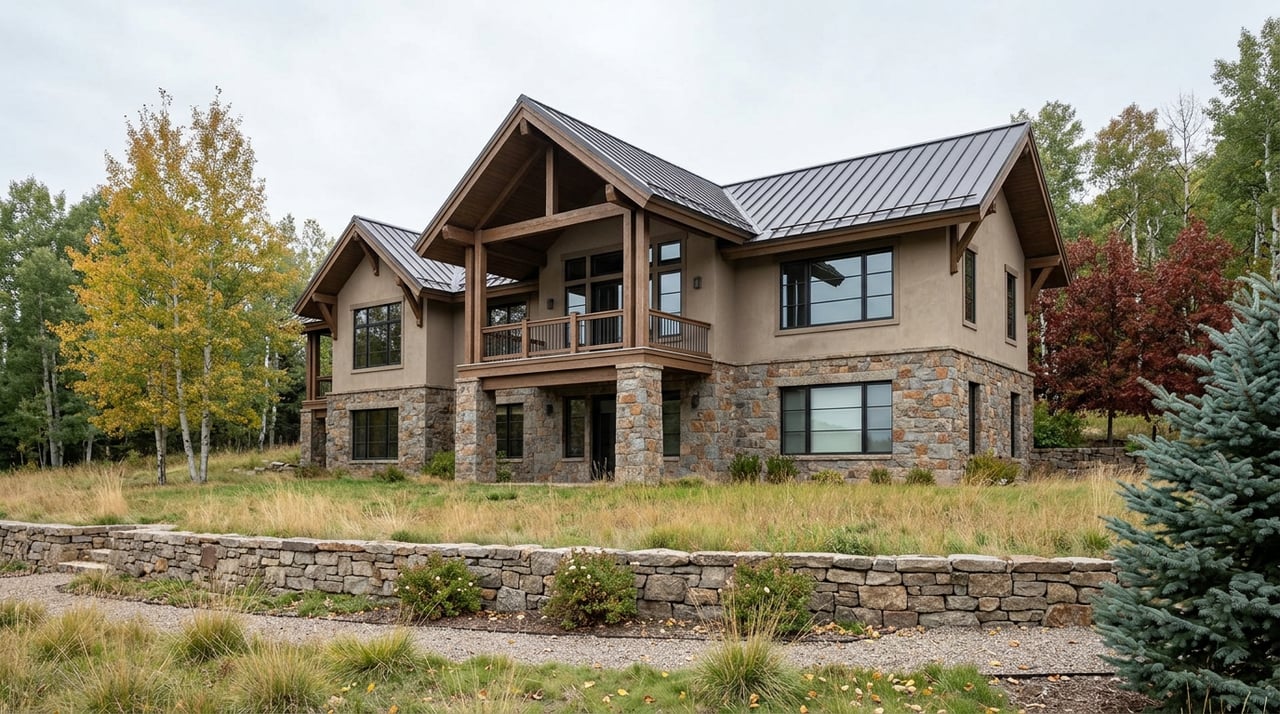
The Six Weeks Between Cordillera's Last Round and First Track
September 10, 2026
September 10, 2026
Drive up to the Mountain Clubhouse on a Saturday in early October and you will catch the community mid-sentence. A foursome is finishing on eighteen, carts parked in a loose row while someone counts out a bet on the last green. Fifty feet away, inside the same building, a staff member is already pulling ski boots and pole bags out of storage, restocking a rental wall that has been empty since April. Nobody treats this as strange. It happens every year, in the same rooms, on roughly the same week, and almost nobody outside the community notices it at all.
That overlap is the real story of Cordillera's shoulder season. The assumption from outside is that golf ends, the valley goes quiet, and then skiing starts, as if there were a gap in the middle where nothing happens. What actually happens is narrower and more interesting: one clubhouse changes its job description while the golf courses around it close on three different schedules, staggered by elevation, and the six-to-eight weeks in between aren't empty so much as they're doing different, quieter work.
Cordillera's identity has always been built on three golf courses that don't behave like one club. The Valley Course, designed by Tom Fazio, sits at the lowest elevation of the three and takes full advantage of it, running well into October in most years because the southern exposure and lower altitude buy it extra weeks that the other two courses don't get. The Mountain Course, Hale Irwin's design carved into former ranch land, sits noticeably higher and tends to wind down earlier, inside the October shoulder-season window that golf trip planners flag as carrying real weather risk at this elevation. The Summit Course, Jack Nicklaus's design at the highest point in the community, closes first, simply because 9,000-plus feet of elevation stops cooperating with turf and temperature before the other two courses feel it.
None of this is a secret inside Cordillera. It's baked into how the club talks about itself: the Valley Course is pitched, in its own materials, almost as an invitation to ski in the morning and play golf in the afternoon on the same day, because for a few weeks each fall and spring, that's a real option rather than a marketing line. The other two courses don't get that pitch, because their elevation doesn't allow it.
| Course | Designer | Elevation | Season character |
|---|---|---|---|
| Valley | Tom Fazio | Lowest of the three | Longest season, extends furthest into fall |
| Mountain | Hale Irwin | Mid-elevation | Closes earlier than Valley, inside the October shoulder-season risk window |
| Summit | Jack Nicklaus | Highest, above 9,000 feet | Shortest season, first to close |
The point isn't which course is best. It's that Cordillera doesn't have one closing day. It has three, and the gap between the first and the last tells you something about how the community is actually built around elevation rather than around a single shared calendar.
The Mountain Clubhouse is where the seasonal handoff is most visible, because it is the building that becomes the Nordic Center once the snow settles in. The same structure that racked golf clubs all summer starts grooming cross-country and skate-ski track, typically running six days a week from mid-December through March, closed on Mondays, open the rest of the week from 9 a.m. to 4 p.m. Timber Hearth Grille, the restaurant inside that clubhouse, doesn't close for the transition. It's the one constant in the building while everything around it changes purpose, which is why it ends up carrying more of the community's social calendar in December than any other room in Cordillera.
The Nordic side of the operation is more built out than a casual resident might expect. Beyond the groomed ski track there are miles of snowshoe trail and a dedicated network for fat biking, all accessed from the same building, with rentals and lessons available on site. Sleigh rides run out of Bearcat Stables, in the Squaw Creek Valley section of the community, on the site of an early-1900s homestead built by the Bearden family. Once the snow is deep enough, a horse-drawn sleigh becomes the way a lot of residents get to dinner at Timber Hearth Grille, which is a genuinely different way to arrive at a restaurant than the golf cart that got you there in July.
None of this exists yet in early October. It exists in mid-December. The six-to-eight weeks between the last competitive round on the Mountain Course and the first groomed ski track is the period when the building is between identities, not without one.
The gap looks emptier than it is if you only track golf and skiing. Several things in Cordillera run on their own calendar entirely.
The trail system does. Two of the better fall hikes in the area share a trailhead near Cordillera, off Squaw Creek Road, at the hairpin turn where most drivers instinctively bear onto Fenno Drive. Staying straight instead of turning leads to the shared start of the Squaw Creek and Stagg Gulch trails. Squaw Creek is the mellower option, running about four miles out to the Elk Park meadows, while Stagg Gulch is steeper and gets to the high point faster. Hikers who want both sides of the mountain link them into a loop. This is peak-color territory in a normal fall, and it's open the entire stretch between golf and skiing, no membership or season pass required to use the trailhead itself.
The Eagle River access doesn't wait either. Cordillera holds private access to 1.3 miles of the river, and fall fishing on that stretch runs independent of what's happening at either clubhouse.
The Trailhead Clubhouse and its Athletic Center are the other constant. That building runs year-round regardless of golf or ski season, with an indoor pool, an outdoor spa, tennis and pickleball courts, and the Cordillera Day Camp operation known locally as Cordy Camp, complete with its own outdoor pool and teepee structures for kids. If the Mountain Clubhouse is the building with two identities, the Trailhead Clubhouse is the one that never changes at all, which is part of why it functions as the connective tissue of the community during the weeks when the golf courses and the Nordic Center are both between seasons.
There's a business logic underneath all of this that's easy to miss if you only think about Cordillera as a place to live rather than as a club with a balance sheet. In December 2024, Troon, which had managed the Club at Cordillera on a third-party basis since 2013, purchased the club outright from Wind Rose Holdings, ending more than a decade of a management-only arrangement. The acquisition came on the heels of a multi-million-dollar renovation of the Valley Club's pool, tennis, and fitness facilities completed in 2023, and Troon followed it with a bunker renovation on the Valley Course in 2025.
That's not a random course to invest in first. The Valley Course is the one with the longest season, the lowest elevation, and the most days of actual play per year. Put money into turf and infrastructure at the course that gets used the most months out of twelve, and the return shows up faster than it would on a course that's playable for four months and buried in snow for the rest. The elevation hierarchy that determines when each course closes is the same hierarchy that appears to be shaping where ownership puts its renovation dollars.
None of this changes anything about how someone should time a visit or plan a season around Cordillera. What it changes is the assumption that there's dead air between October and December. There isn't. There's a staggered set of closings driven by elevation, a single building doing two jobs in sequence, a trail system and a river that don't care what the clubhouse calendar says, and a renovation budget that seems to follow the same logic as the tee sheet. Residents who've been here a few seasons already know this rhythm without naming it. For anyone newer to the community, or anyone weighing how a property here actually gets used across twelve months instead of just the peak months, it's worth understanding before the assumption of an empty stretch sets the wrong expectation.
If you're thinking through how a home in Cordillera, or elsewhere in the Vail Valley, actually fits the way you'd use it across all four seasons rather than just the postcard ones, that's the kind of question Kevin Kuebert works through with buyers and owners in this community regularly. Let's Connect.
Stay up to date on the latest real estate trends.
Partner with Kevin for expert guidance in buying or selling real estate in the Vail Valley. His experience and integrity ensure a smooth and successful process. Contact Kevin to start your real estate journey!