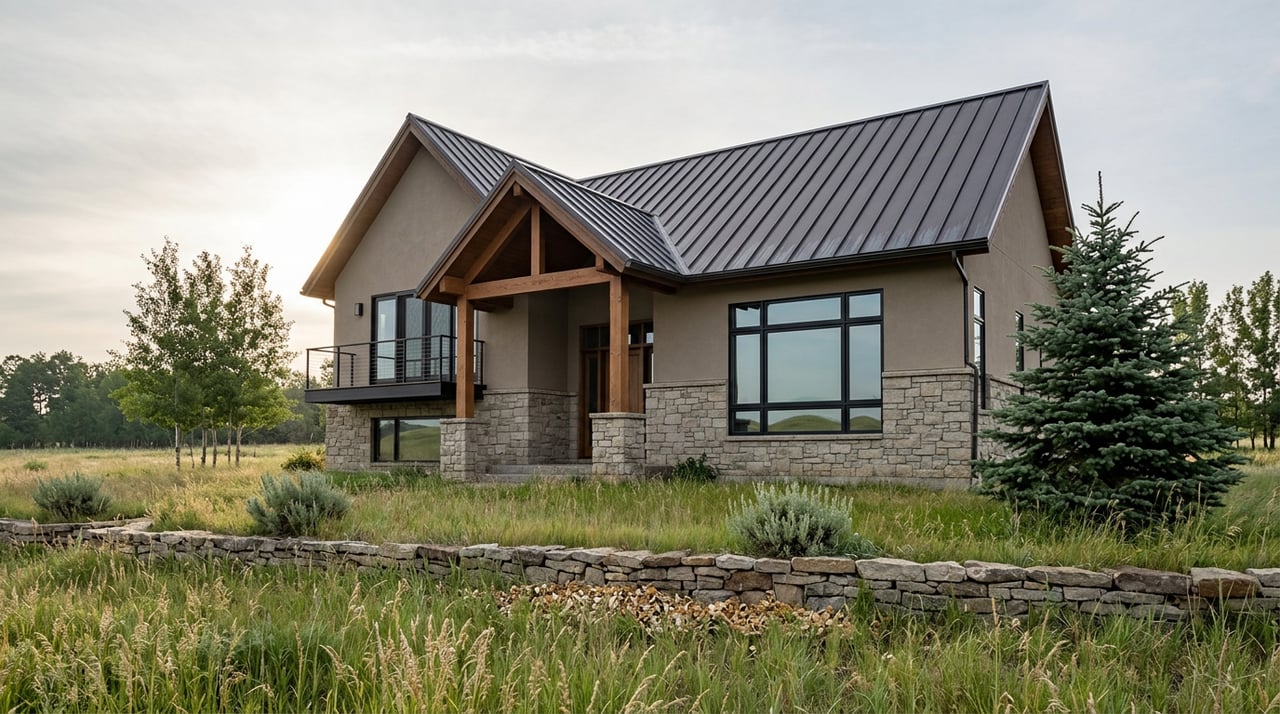
Eagle's Median Price Is Up 27 Percent. Its Price Per Square Foot Isn't.
September 3, 2026
September 3, 2026
Drive down Haymeadow Drive on the south side of Eagle this month and you'll pass a 2,522-square-foot single-family home on the market this summer asking $2,338,000, or $927 a square foot, with open houses still scheduled as of this week. Keep driving and you'll reach a cluster of two-bedroom condos in the same master-planned development that started selling for $400,508. Same subdivision. Same builder standards. Same zip code. A price gap of nearly six figures per unit of space.
That gap is not a fluke. It's the reason Eagle's headline numbers this year read like two different markets pretending to be one. Multiple listing service figures for the three months ending May 2026 put Eagle's median sale price at $1.3 million, up 27.5 percent from the same period a year earlier. Over that same window, price per square foot actually fell 10.6 percent to $445. A market cannot be getting dramatically more expensive and cheaper per square foot at the same time unless the mix of what's selling has changed underneath the number. In Eagle, it has.
The upward pull comes from remodeled custom homes in established neighborhoods like Eagle Ranch's Uplands, where a "Bunkhouse" listing this year advertised more than $255,000 in fully permitted 2026 renovations, including a new roof, solar system, and redesigned great room, on a 3,937-square-foot home on a private half-acre lot. Homes like that sell for a lot of money and they sell on the strength of the work put into them, not just the dirt underneath.
The downward pull on price per square foot comes from the other end: new construction at Haymeadow, the 660-acre conservation-oriented development along Brush Creek where the Eagle County Housing and Development Authority purchased 43 two-bedroom condominiums outright and is reselling them with permanent, price-capped deed restrictions. Those units run from roughly $400,508 to $558,609. They're small, efficient, and priced to be attainable, and every one that closes drags the per-square-foot average down even as it adds a unit to the sale count that inflates headline activity.
| The Uplands remodel | The Haymeadow condo | |
|---|---|---|
| Example | Custom home, Eagle Ranch Uplands | Two-bedroom condo, Haymeadow Phase 1 |
| Approx. size | 3,937 sq ft | 2BD/2BA layout |
| Price point | High six figures to low seven figures | $400,508 to $558,609 |
| Status | Free market | Price-capped, deed-restricted |
| Effect on median | Pulls the median price up | Pulls price per square foot down |
Separate list-price data for July 2026 showed asking prices around $1.59 million with homes sitting a median of 79 days, compared to 15 days for homes that actually sold in May. Put together, that's a market where top-end product is sitting longer while smaller, subsidized product moves fast. A median calculated across both tells you almost nothing about what either one costs.
If you're a local buyer trying to figure out what Eagle actually costs, the $1.3 million median is close to useless without a second number: what Eagle County will pay toward your purchase if you qualify.
The county's Good Deeds program, run through Housing Eagle County, will contribute up to 15 percent of a purchase price, capped at $187,500, in exchange for recording a deed restriction on an open-market home anywhere in the county. Do the math and the cap tells you the ceiling of the program: 15 percent of $1.25 million is $187,500, which is also the maximum purchase price the program allows. A separate Community Partner Program layers a matching contribution from a participating town or organization on top, bringing the combined buy-down to 30 percent, capped at $375,000, in communities that include Avon, Vail, Eagle Ranch, and Basalt. The buyer still has to bring a minimum 3 percent down payment from their own funds. The program's popularity is its own evidence of how badly that gap needed closing: the county's initial $4 million 2026 budget for Good Deeds was nearly depleted by June, prompting an additional $2.5 million mid-year allocation that officials described as a one-time infusion, not a permanent expansion of the program.
That $187,500 figure is close to the "up to $189,000 in local buyer support" language that's shown up on recent MLS listings for entry-level Eagle homes, the kind of detail that makes a listing advertised at a modest price actually cheaper to carry than renting, once the buy-down is applied at closing.
"Haymeadow represents a rare opportunity for homebuyers to purchase new construction at prices well below the market average," said Kim Bell Williams, Eagle County's housing director, when the county announced the Haymeadow units for sale, adding that the last comparable opportunity had come in 2006 with the Miller Ranch development. Two decades between openings is a useful way to understand why demand outpaces funding the moment a new batch of units hits the market.
Here's where a buyer comparing neighborhoods needs to slow down. Eagle Ranch shows up twice in this picture, and the two programs attached to its name are not the same program.
As a Community Partner Program participant, Eagle Ranch buyers can potentially access the county's 30 percent combined buy-down, capped at $375,000, the same structure available in Avon and Vail. Separately, and predating that partnership, the Eagle Ranch Housing Corporation runs its own standalone deal: a flat 10 percent of purchase price toward homes within the Eagle Ranch planned unit development, capped at a $600,000 purchase price, tied to its own ERHC deed restriction rather than the county's price-capped covenant. Two different entities, two different caps, two different sets of resale rules, both attached to homes carrying the same neighborhood name. A buyer who assumes "Eagle Ranch" means one program is going to be surprised at the closing table.
The buy-down is not free money. It's a trade, and the terms of that trade matter more the longer you plan to own the home.
Price-capped deed restrictions limit future resale appreciation to between 0 and 3 percent simple interest annually, a number set at closing and locked in for as long as the restriction runs, which is perpetual. A separate resident-occupied restriction option, used in some tiers of the program, caps the subsidy at a smaller percentage but doesn't cap appreciation the same way, trading a smaller upfront benefit for more upside later, and instead requires The Valley Home Store, which administers the program, to approve the next buyer when the home eventually sells. Either version requires the owner to use the home as a primary residence, forbids owning other residential real estate while holding the deed-restricted property, and requires annual recertification of eligibility. When the home does resell, a 2 percent transactional brokerage fee applies under the program's standard terms.
None of that makes the program a bad deal. It makes it a specific deal, and the size of the buy-down should be weighed against how long you expect to stay, whether you might inherit or acquire other property down the road, and whether the appreciation cap matters given how you actually plan to use the home.
Is a Haymeadow condo the same thing as a Good Deeds home? No. The county purchased Haymeadow's 43 condos directly and resells them with a price-capped restriction already attached. Good Deeds instead converts an existing open-market home anywhere in the county into a deed-restricted one at the time of a private purchase.
If I take the buy-down, can I ever sell for full market value? No. Price-capped restrictions limit resale appreciation to 0 to 3 percent simple interest annually, and a 2 percent brokerage fee applies at resale.
Does the program mean I can't own another home nearby? Correct. Program rules prohibit owning other residential real estate while holding a deed-restricted property, and eligibility is recertified every year.
Should sellers under $1.25 million care about any of this? Yes. That's the program's purchase-price ceiling, and it's exactly where Good Deeds and Community Partner buyers are shopping with $187,500 to $375,000 in assistance behind them, a buyer pool the headline median doesn't reflect.
Eagle's number this year is a mix problem before it's a market problem. If you're trying to figure out what a specific home is actually worth, or what you'd actually pay after assistance, that's a conversation worth having before you make an offer, not after. Kevin Kuebert has spent 19 years working these exact micro-markets across the Vail Valley and can walk you through which number in an Eagle listing is real. Let's Connect.
Stay up to date on the latest real estate trends.
Partner with Kevin for expert guidance in buying or selling real estate in the Vail Valley. His experience and integrity ensure a smooth and successful process. Contact Kevin to start your real estate journey!